


 Back
Back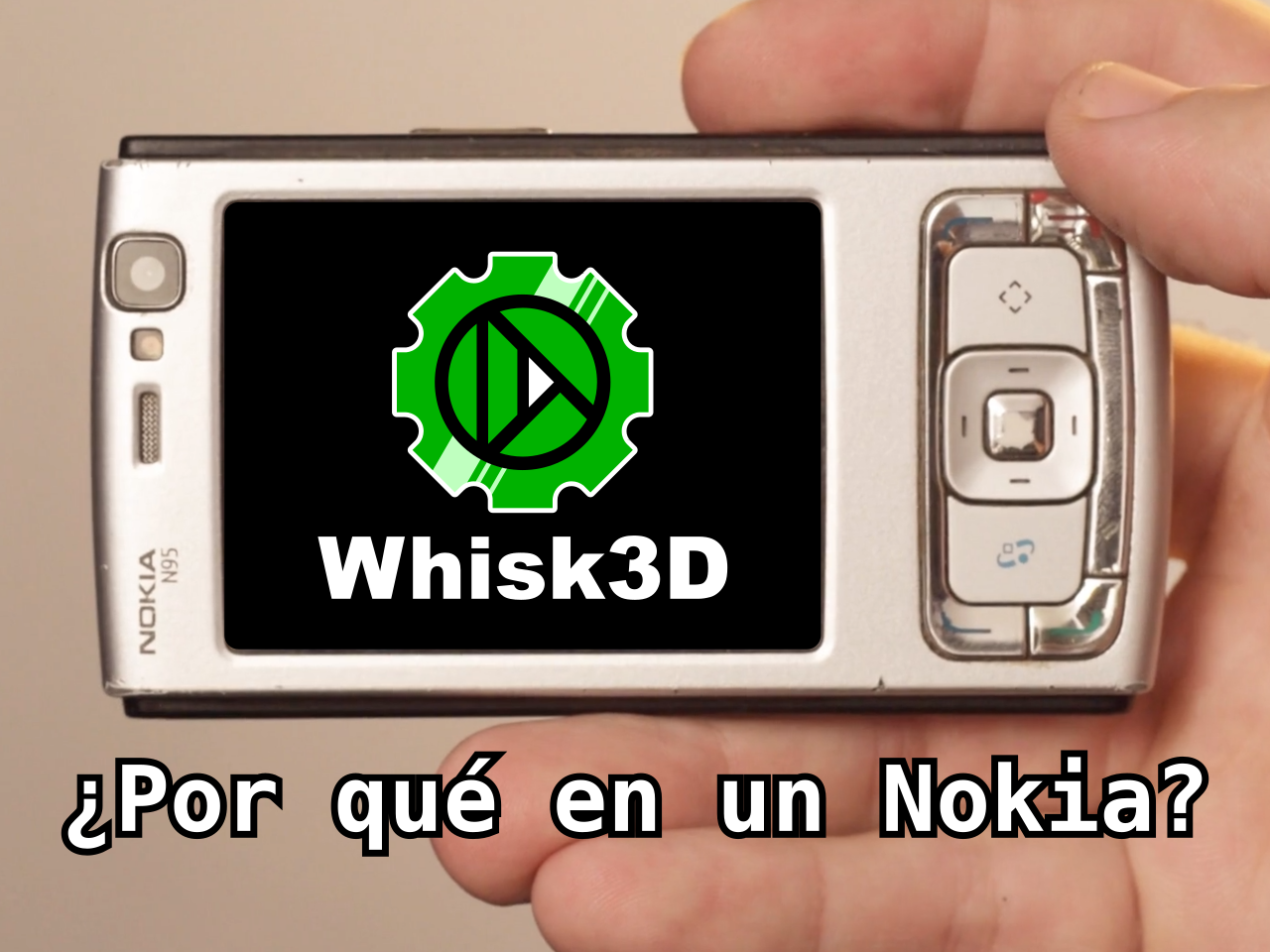

 Light mode
Dark mode
Light mode
Dark mode


Every time I show Whisk3D running on a 2007 Nokia N95, the first reaction is the same: "why on an old Nokia?". And the second one, as soon as they see it running smoothly: "why does it work so well?". This article answers both, and along the way tells you something I think we all should know.
The short answer to the "why" is a provocation: I want to prove that you don't need a computer or a graphics card worth thousands of dollars to do 3D modeling, animation and rendering. That if this runs on a nearly twenty-year-old phone, it runs on anything. And that 3D art stopped being a luxury for the few.
Because the Nokia N95 wasn't just any phone: for its time, it was a beast. Inside it has a Texas Instruments OMAP 2420 chip with an ARM11 processor at 332 MHz, with a hardware floating-point unit (FPU) (key for 3D math), and above all hardware-accelerated 3D graphics: a real GPU, the PowerVR MBX, the same family of graphics chips the first iPhone would use years later.
| Nokia N95 (2007) | Specification |
|---|---|
| CPU | ARM11 at 332 MHz (TI OMAP 2420 chip) with FPU |
| GPU | PowerVR MBX: hardware 3D acceleration |
| Graphics | OpenGL ES 1.1 (millions of triangles per second) |
| RAM | 64 and 128 MB (the 128 MB, in the US N95-3 and the N95 8GB) |
| OS | Symbian OS 9.2 (S60v3 Feature Pack 1) |
That RAM detail matters: the American versions (the N95-3 NAM) and the N95 8 GB came with 128 MB of memory, double the original model. That's more than enough to model in 3D. And the GPU speaks OpenGL ES, which is basically the same graphics language used by the computers that made the movie effects of the 90s.
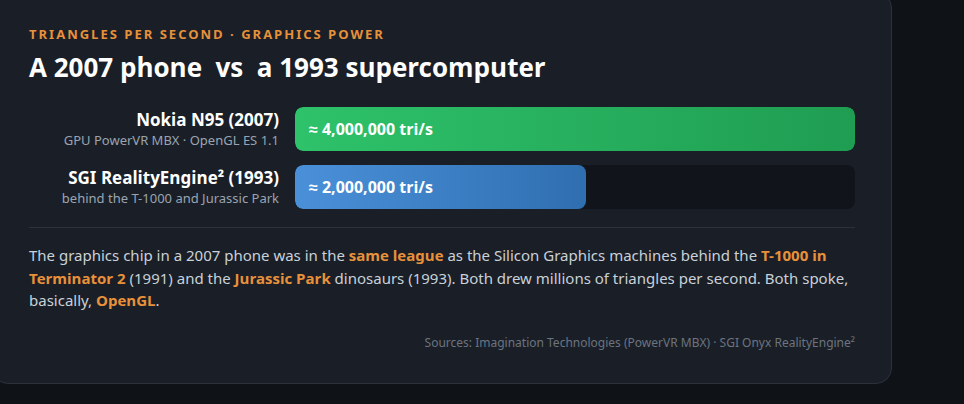
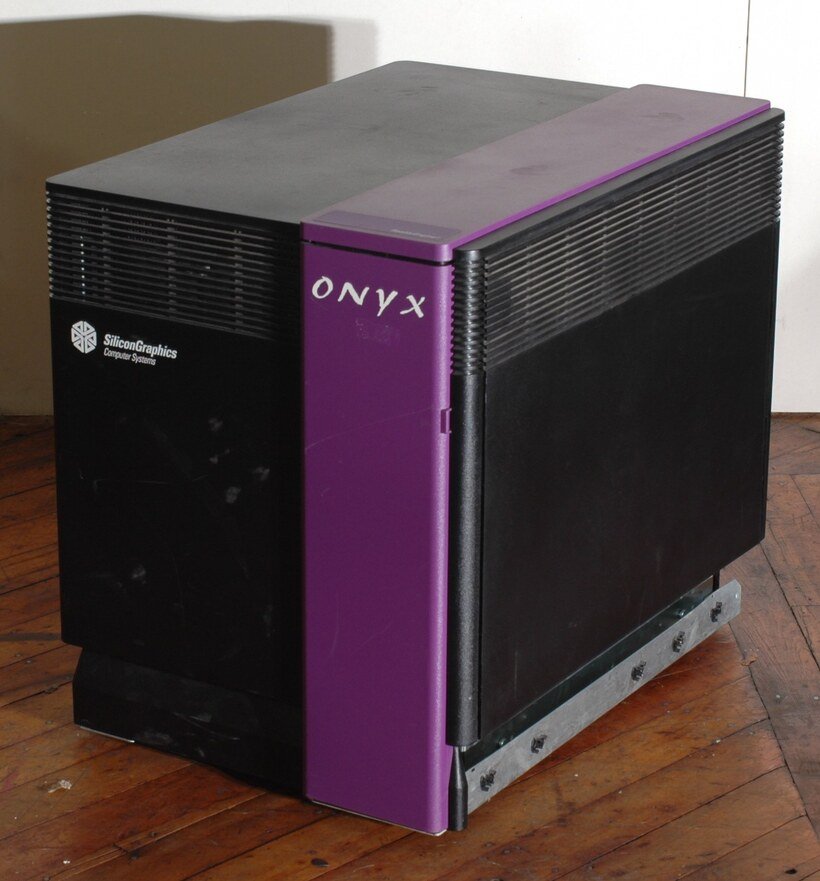
The effects of Terminator 2 (1991, the legendary T-1000) and Jurassic Park (1993) were made on Silicon Graphics (SGI) computers. Their flagship machine, the SGI Onyx RealityEngine² (1993), drew over a million textured triangles per second. It was, literally, a graphics supercomputer.
Now look at the numbers side by side. The chip in a 2007 phone was in the same order of magnitude as that 1993 supercomputer. Both drew millions of triangles per second. Both spoke OpenGL. The difference was the price, not the concept.
| Nokia N95 (2007) | SGI RealityEngine² (1993) | |
|---|---|---|
| What it was | A phone | A graphics supercomputer |
| Triangles/sec | Millions | Over 1 million (textured) |
| Graphics API | OpenGL ES | OpenGL |
| Used for | Calls, photos… and then the trash | Terminator 2, Jurassic Park |
| Price | US$ 730 | US$ 250,000 |
And here's what makes me angriest: that phone, with the graphics power of a quarter-million-dollar supercomputer, was used to make calls and take photos. And when the next model came out, it was thrown away. Today an N95 is dismissed as old junk… when inside it has a chip capable of serious 3D. It's not junk: it's wasted hardware. Whisk3D is, in part, a way to prove it.
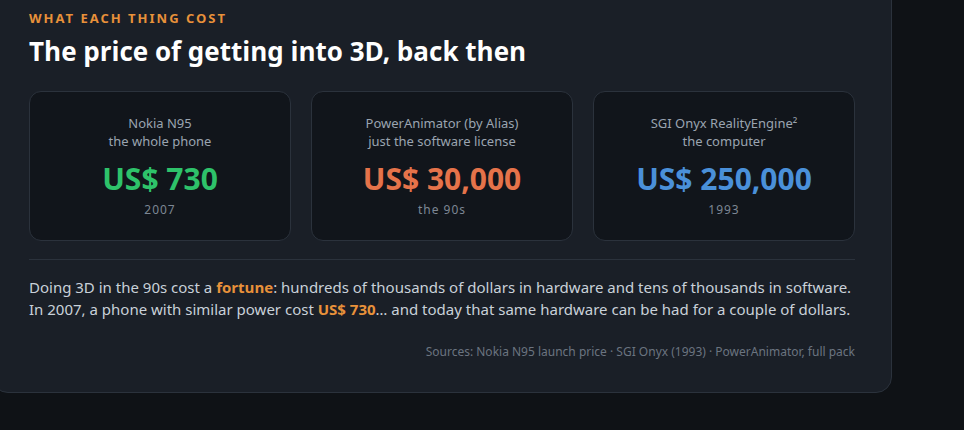
An SGI Onyx cost about US$ 250,000 in 1993. And that was just the hardware: the software to animate, like PowerAnimator, from the company Alias, used to make Jurassic Park, cost US$ 30,000 for the full pack. Add machine rooms, air conditioning and people who knew how to use it. 3D was an incredibly expensive, closed club.
The N95, on the other hand, launched at US$ 730 in 2007. Very expensive for a phone, yes… but with graphics power similar to that supercomputer, in your pocket. And I already knew one thing: that this very hardware, over the years, would become available for a couple of dollars.
True. A single computer would take forever. But here's the secret almost nobody mentions: no movie was ever made with a single computer. They're made with render farms.
A render farm is a bunch of computers working as a team. A movie has over 100,000 frames (24 per second, for an hour and a half). Instead of rendering them one after another on a single machine, they're split across many machines at the same time. Toy Story has 114,240 frames, and Pixar rendered them with a farm of 117 Sun computers running 24/7, using RenderMan, the software Pixar itself created for the job. In total it was about 800,000 compute hours: each frame took on average about 7 hours (and the heaviest ones, up to 30).
Those 800,000 hours, on a single computer, would be over 90 years. On the farm, split across 117 machines, it was a few months. That's the magic of distributed rendering.
With that logic, the question changes. Could an N95 make a movie? On its own, no. But a thousand N95s in a farm, yes. The concept is exactly the same one Pixar used; only the scale changes.
And today it's even crazier: a single computer with a modern graphics card is like having thousands of N95s working together. That render farm that used to fill a room with over a hundred machines now fits inside a single GPU. You no longer need a room full of computers: the whole render farm is in your own machine.
And here's a fact that blows my mind: today we talk about "2K" and "4K" like they're the latest thing… but they were already working in 2K back in the 90s. Effects and film scans were done at a resolution of around 2048 × 1556 pixels. It's not exactly today's "2K" (digital cinema 2K is 2048 × 1080), but it's in the same ballpark: over two thousand pixels wide, back then.
And why was that enough for the giant cinema screen? Because the digital image was printed onto 35 mm negative, onto real photochemical film. Passing through the film, the pixelation disappears: you don't see pixels, you see film grain. It looked flawless.
Now think about it the other way around: if back in the 90s, with those machines, they were rendering in 2K… what can you do today?
To give you an idea: the photos a Nokia N95 takes are 5 megapixels, that is 2592 × 1944 pixels. That's already bigger than the 2K the Jurassic Park effects were made in! And just a couple of years later you had the Nokia N8 (2010), with 12-megapixel photos (4000 × 3000). Not to mention the Nokia 808 PureView (2012): excellent hardware, with 1080p HDMI output and 41-megapixel photos (7728 × 5368). All of that, in a phone.
Thanks to advances in technology, today there are tools like Blender and Whisk3D that put all that power within everyone's reach, for free and on any machine. You no longer need a supercomputer or a US$ 30,000 license. With these tools you can make short films, series and movies.

An example? Flow (2024), by Latvian director Gints Zilbalodis. A film made entirely in Blender and rendered with EEVEE (its real-time engine), where each frame took from half a second to ten seconds at 4K. It was made by a small team of artists, with free software… and it won the Oscar for Best Animated Feature, becoming the first Latvian film to win an Oscar. Something unthinkable a few years ago, when that was only within reach of studios with multi-million-dollar budgets.
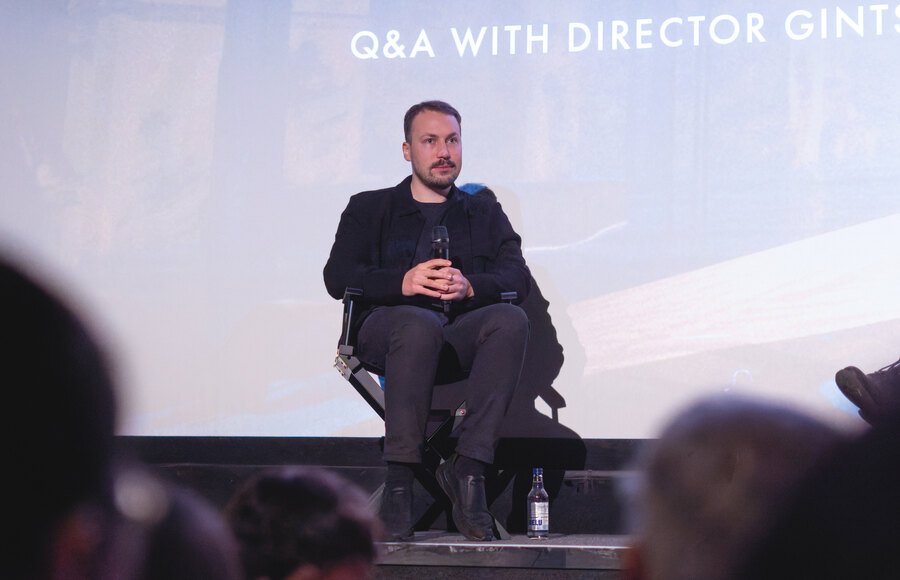
"Any kid now has the tools to make Academy Award-winning films."— Gints Zilbalodis, director of Flow, thanking Blender
The N95 was very expensive when it came out. But I knew that this exact same hardware would become available years later for pennies. And it came true… halfway. Because, sadly, they keep selling us phones that are not only expensive, but ever more expensive. Now people "get" the value of a smartphone and are willing to pay more.
And why do you need 8 or 16 GB of RAM and 8 cores? In the vast majority of cases, you don't. You need them because the software they make for you is bloated garbage, built on systems that spy on you and control you, like Windows, iOS and Android. They give you expensive, powerful hardware to make up for ever-worse software. It's planned obsolescence, and it leaves mountains of electronic waste.
With this project I want to prove the opposite: that with a much cheaper phone (a couple of dollars) anyone can enter this beautiful profession that is 3D design. That it stopped being something exclusive to a few and today is accessible to everyone. That you can learn with online courses, by reading, by watching videos on YouTube.
And what about artificial intelligence, which now does everything in two clicks? Don't get discouraged. There is so much work to do, and today we have more tools than ever to do it. The creativity is still yours.
This article is meant to raise awareness. To demand phones that are more accessible, repairable, maintainable and affordable. Enough with electronic waste and planned obsolescence. Enough of being sold overpriced hardware just to cover up ever-worse software. Let's use GNU/Linux and free software. Let's stop using software that spies on us, controls us and makes us dependent.
You can create beautiful art with whatever you have on hand. An old Nokia, a netbook, whatever computer. The barrier is no longer money or hardware: it's you and your drive. So grab whatever you've got and start creating. 💚


